
I have been reading All About Love by bell hooks.
I know, I am very late to the party for reading bell hooks.
Especially when I work in participatory arts and cultural education and outreach, where bell hooks is quoted many times over, and with good reason. She has said profound things that have helped us deconstruct and reconstruct the way we look at education, like:
‘What we cannot imagine cannot come into being.’
Relevant in to today’s discourse around identity and representation in the arts and other public-facing industries.
‘The classroom, with all its limitations, remains a location of possibility.’
Giving teachers and students the confidence to question authority and pinpoint systemic barriers to bring about change.
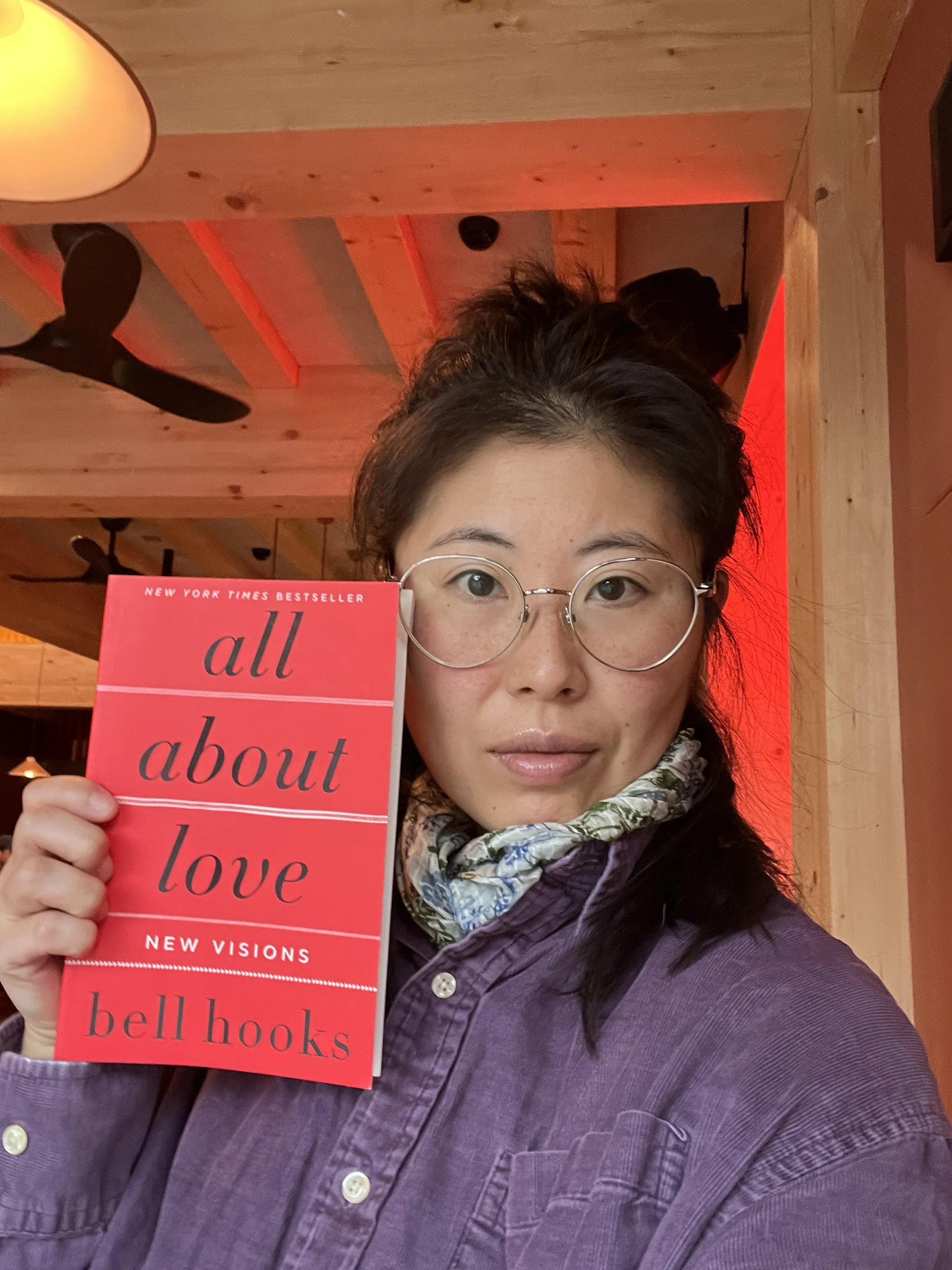
Me with bell hooks’ book: All About Love
I dived into her book eager to learn about love. I don’t consider myself somebody who understands love.
You’re probably thinking who understands something so grand, complex and intimate as love, anyway? Good point.
For me it was always the western notion of love with its millennia-worth of baggage from Christendom that made me feel confused by it.
This might be because my early years were spent in Japan, and so, the love I received from care-givers was love unbeknownst of Christian-thought. Then I moved to England and was sent to a Christian boarding school, where the notion of love (it was primarily talked about in theology – bible class) was very different to anything I’d experienced before.
Which left me wondering what on earth was love all about?
My upbringing probably put me in good stead for studying anthropology and archaeology, though it didn’t do wonders for my emotional development. I am still a work in progress.
In her book, bell hooks is asking why don’t we use love – arguably the most powerful force – as a serious principle in the way society is run? Is it because the patriarchy considers love to be a girly emotion, and if it’s something in the woman’s domain, then we cannot take it seriously or see it as vital?
She also questions why (as she was doing a literature review about love) so much of the authority on love is written by white male poets and critics; often on the topic of unrequited love i.e. yearning after a maiden, or the derangement that comes from love. bell hooks does not think this is a rounded or diverse write-up about love.
She talks about childhood love.
The parent-child bond and how if that relationship is at odds, like a parent is violent and hits a child for punishment, then this erodes away at what love really is. She talks about how love is actually a proxy for justice, but too many of us don’t get love in the way we deserve, even from a very young age, and this can distort our understanding of justice.
What bell hooks says is hard to swallow but makes sense. She says that imagine if you love your mother but then she maltreats you, you end up re-adjusting your ideas of what love is (and therefore what is just to do unto others), so that it can fit around the horrible experiences with your mother. Love is a malleable and alive thing.
Then she talks about honesty.
How honesty is also linked to love, because to be able to love fully with your whole being, you’ve got to be able to be honest with yourself, and with others.
This is a very hard task. Especially in a society where looksmaxxing, saying everything ‘is fine’, being strong and not needing to ask for help is the norm. To love is to be honest thus vulnerable. Yet, too often in our lives we withhold some truth (not say anything) or get caught in a lie because it is inconvenient or destabilising to tell the truth.
In the first few chapters of her book, I learned so much. I was left chewing over hooks’ words and trails of thought, as they were simple yet profound points she was making.
Sure, the book was written in the 1990s from an American perspective, so some of the feminist arguments weren’t as relevant to me today, but then in many respects we have gone backwards. bell hooks was writing with an open-heart and optimism for change. How refreshing.
A part that resounded strongly for me still was on the topic of masculinity:
The very concept of “being a man” and a “real man” has always implied that when necessary men can take action that breaks the rules, that is above the law. Patriarchy tells us daily through movies, television, and magazines that men of power can do whatever they want, that it’s this freedom that makes them men. The message given males is that to be honest is to be “soft”. The ability to be dishonest and indifferent to the consequences makes a male hard, separates the men from the boys.
That’s some real clear thinking from bell hooks that I would not have arrived at on my own. I had never considered the hero’s journey in terms of patriarchy.
There are many more chapters that delve into big concepts to do with love, such as compassion, divine love, mutuality, ethics.
There is a chapter about death.
Reconciling that death is part of life allows us to love more too. Because living with love means facing our fears and accepting them, rather than fighting them.
I’ve noticed (and I’m sure many of you have too) that we’re not very good at talking about death because we fear it, or are in denial about growing older or more infirm, or saddened by remembering people we have lost. Yet, it’s the inevitable turn of events.
If we could be more comfortable talking about grief and death and all the tragic trimmings, then we may be able to break the taboo. But it’s tough.
What bell hooks says resonates with the samurai belief system; I wrote a book called The Way of the Samurai Women.
Samurai culture inferenced death all the time through the transience of things – how the petals fall from a cherry blossom tree after full bloom. How the beauty of lacquerware is found in the gleam of the shine that’s quickly enveloped by the dark ombré. Nature is all things bright and black and beautiful. To live with vitality – live fully – is to accept that death is everywhere, just as much as life is.
This is bell hooks:
In a culture like ours, where few of us seek to know perfect love, grief is often overshadowed by regret. We regret things left unsaid, things left unreconciled. Now and then when I find myself forgetting to celebrate life, unmindful of the way embracing death can heighten and enhance the way I interact with the world, I take to think about whether I would be at peace knowing that I left someone without saying what’s in my heart, that I left with harsh words. I try daily to learn to leave folks as though we might never be meeting again. This practice makes us change how we talk and interact. It is a way to live consciously.
